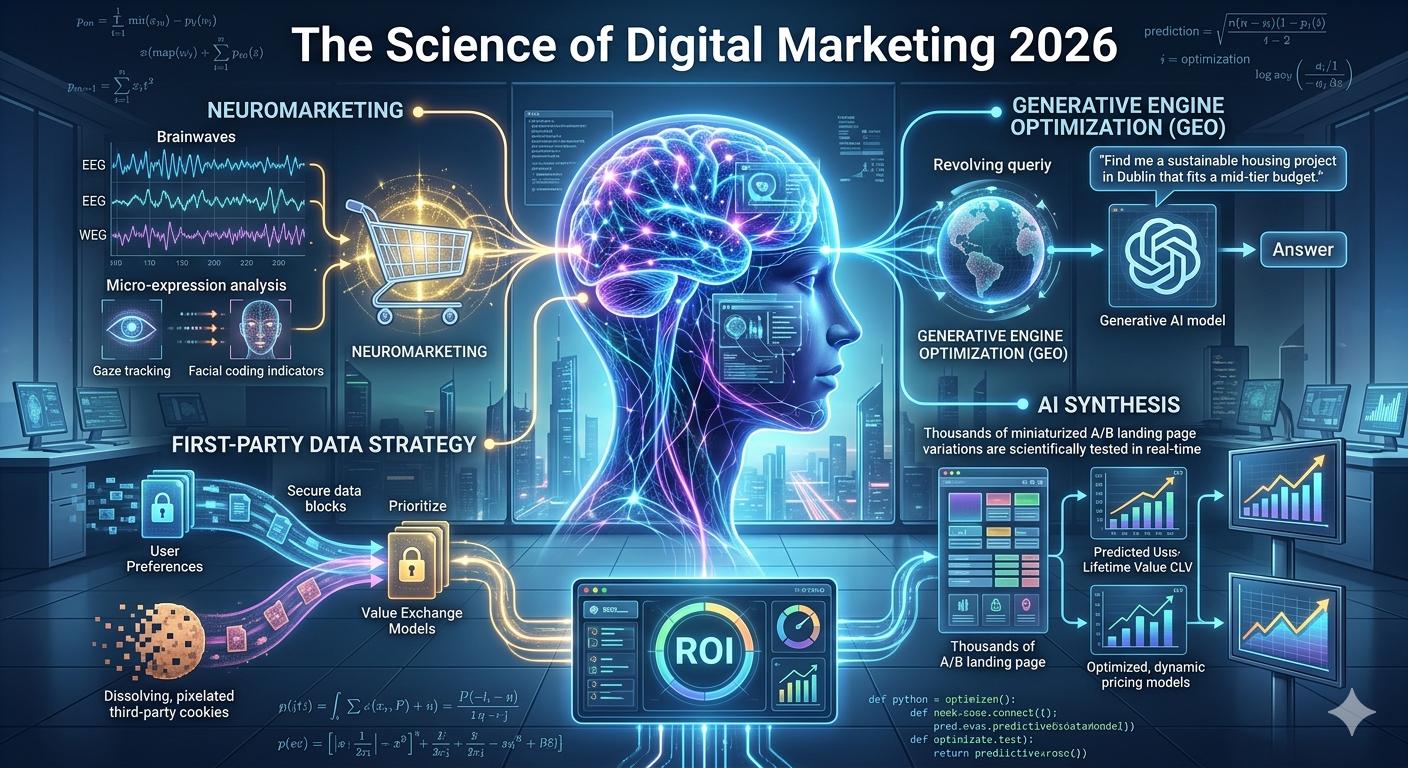
For decades, marketing was whispered to be an "art"—a mystical blend of creative intuition and "gut feelings." But as we navigate 2026, the veil has been lifted. Modern marketing is no longer a guessing game; it is a rigorous, data-driven science. From the neural pathways of the human brain to the generative engines that have replaced traditional search bars, the "Science of Digital Marketing" has become the primary driver of global commerce.
1. Neuromarketing: The Biology of the "Buy"
At its core, the science of marketing begins with biology. We now know that 95% of purchasing decisions occur in the subconscious mind. Traditional surveys and focus groups are increasingly obsolete because humans are notoriously poor at explaining why they do what they do.
Instead, 2026 marketers use Neuromarketing—the study of the brain’s responses to marketing stimuli. By analyzing eye-tracking data, facial coding (to detect micro-expressions), and even biometric sensors that measure heart rate, brands can determine the exact millisecond a consumer feels "trust" or "curiosity."
The 0.3s Rule: In the digital age, a brand has roughly 0.3 seconds to trigger an emotional response before a user scrolls. If the visual doesn't hit the reward center of the brain (the ventral striatum) instantly, the science says you’ve already lost the sale.
2. From SEO to GEO: The Evolution of Visibility
Search Engine Optimization (SEO) has undergone its most radical transformation since the invention of the backlink. We have entered the era of Generative Engine Optimization (GEO).
Keywords are dead; intent and context are the new currency. As AI-powered personal assistants become the primary interface for users, the goal isn't to rank #1 on a list of links—it’s to be the sole answer provided by a generative model.
Key Pillars of 2026 GEO:
- Conversational Logic: Content must be structured to answer complex, natural-language queries (e.g., "Find me a sustainable housing project in Dublin that fits a mid-tier budget and has green space").
- Brand Authority (E-E-A-T): Search engines now prioritize "Experience, Expertise, Authoritativeness, and Trustworthiness" more than ever. Digital marketing science now involves "Author Graph" mapping to verify that content is written by actual experts.
- Visual and Voice Search: Optimization now includes metadata for AR (Augmented Reality) and voice-pattern recognition.
3. The First-Party Data Revolution
The "Dark Ages" of third-party cookies are over. Privacy regulations have forced a scientific shift toward First-Party Data Strategy. Marketing science in 2026 is about building direct, transparent relationships with the user.
Instead of "following" users around the web with creepy ads, brands now use Value-Exchange Models. By offering high-quality educational content, tools, or loyalty rewards, companies gather "Zero-Party Data"—information that users willingly share. This data is then fed into Predictive Analytics models to forecast Customer Lifetime Value (CLV) with startling accuracy.
4. AI Synthesis and Predictive Modeling
The real "mad science" happens in the data pipeline. Automation has evolved from simple email triggers to Autonomous Marketing Systems. These systems use machine learning to:
- A/B Test at Scale: Instead of testing two versions of a landing page, AI can test 2,000 variations in real-time, adjusting layout, color, and copy for every individual visitor.
- Predict Churn: By analyzing behavioral signals (like a drop-off in app engagement or a specific pattern of support tickets), algorithms can predict when a customer is about to leave and automatically deploy a "retention hook."
- Dynamic Pricing: Prices are no longer static; they are scientifically adjusted based on demand, user history, and even real-time inventory levels.
5. The Synthesis: Art Guided by Evidence
If marketing is a science, where does creativity go? It becomes the Hypothesis.
In 2026, the "Creative Director" is more like a lead scientist. They formulate a creative hypothesis ("I believe a short-form video featuring high-contrast visuals will resonate with Gen Alpha's sense of irony"), and the data infrastructure either proves or disproves it within hours.
| Traditional Marketing | Scientific Digital Marketing (2026) |
| Focus on "Mass Reach" | Focus on Hyper-Personalization |
| Success measured by "Impressions" | Success measured by Predictive ROI |
| Content created for "Humans" | Content created for Human-AI Hybrid Search |
| Third-party cookie tracking | First-party / Zero-party data |
Conclusion
The science of digital marketing is a balance of empathy and evidence. While the tools—AI, neural mapping, and GEO—are cold and clinical, their purpose is to create more human, relevant, and helpful experiences. To succeed in this landscape, one must be part data scientist, part psychologist, and part storyteller. The brands that win are those that understand that while the algorithm delivers the message, the human heart still makes the final call.
Does your current digital strategy lean more toward "traditional guesswork" or "scientific precision"?
By Seyi Olajumoke